Saturday, May 21, 2011

Back in Bukoba - Rain, rain go away

We've been back over a week now and the rain has been amazing.  Yesterday and today have been the wettest days since we've been here.  We've had heavier downpours but nothing as sustained as this current stuff.

Yesterday Jenny wanted to take some of her maths books up to the Missenyi District schools around Kyaka and Bunazi so we planned a visit to Minziro as well.  It rained until nearly noon then we headed off into the gloom and low cloud.  Many of the drivers even had their lights on!!  By the time we got to Kyaka and dropped off the books the weather had cleared and there were a few sunny patches.  We decided to postpone Minziro (the forest floor would be a lake at the moment) and instead went down the Karagwe road to the acacia woodland survey site I found a few months ago. 

Our regular spot was very wet and muddy so we tried a different nearby area with a dry track.  Everywhere we stopped there were birds - active now the rain had finally stopped.  We saw 42 species in an hour or so.  Three were lifers for me - Flappet Lark, Marico Sunbird and Cardinl Quelea.  Other notable species were Meyer's Parrot, Bare-faced Go-away-bird, Blue-naped Mousebird, African Grey Hornbill, Greater Honeyguide, Nubian Woodpecker, Fork-tailed Drongo, Moustached Grass Warbler, Variable Sunbird, Thick-billed Weaver and Common Waxbill.

This is potentially a great spot and I really need the rain to stop so I can get in to explore the area properly.  Lots of species on the Kagera list that I've been missing are probably in this drier woodland.  Time is running out here for us however and today's deluge won't help.

On the way home we saw a pair of Common House Martins near Kyaka.  These have rarely been recorded in Kagera and should be back in Europe by now.  The most tantalising sighting of the day was an all dark, long-streamered swallow that whizzed across the highway  in front of the car a few km south of Kyaka.  We both called it as a probable Blue Swallow but couldn't be 100% sure.  These are rare African birds.  In Tanzania they breed in the far south then migrate north into Uganda about now.  There have been a few sightings in grassland in Kagera near Minziro and around Bukoba.

Here are recent pics of a Western Banded Snake-Eagle near Kyaka and a Brown-backed Scrub-Robin from Katoke.


Western Banded Snake-Eagle

Brown-backed Scrub-Robin


Bukoba 21st May 2011

Saturday, April 30, 2011

An Australian interlude

The sad death of Jenny's mum, Jean, recently (see Jenny's beautiful tribute) has seen us back in Australia for two weeks. 

While Jenny has gone to Wodonga I've had a day in our home town of Hamilton and have enjoyed traveling through rural western Victoria and catching up with a nice selection of Aussie birds.

While we've been away most of Victoria has had record rainfall and most wetlands, swamps and lakes are now nearly full with winter still a month away.  Many of these have been dry for years, some for decades.  Our dry forests are now bursting with new growth and bird populations are sure to get a boost in the coming breeding season.

The farmland is also looking well-watered and late-April is when the countryside tends to look its best.  Hamilton itself was a picture and the overall culture shock of suddenly being back in a rich, prosperous country with all the modern trappings was a bit overwhelming.  Hopefully I will never take it all for granted again.

So although I'm missing my Plantain-eaters and Sunbirds it is great to wake up to Butcherbirds at my Dad's house in Melbourne and see Kookaburras and Currawongs in the forests, flocks of Cockatoos and Corellas along the highways and a host of diverse waterbirds on Lake Linlithgow - my favourite  local wetland.

Here's a pic of the Meredith Forest Reserve (box and stringybark eucalyptus forest) and one of some Royal Spoonbills on the edge of Lake Buninjon.


Melbourne 1 May 2011

Monday, April 11, 2011

The swamps are filling up

In recent weeks we have see the big wet season arrive.  The Bukoba district has two wet seasons - this is the shorter but wetter of the two. The rain now is really important in setting up the rest of the year in terms of food production.  In recent years the rain has been unreliable and production has been down - particularly to our south and west.

This year everyone seems to be happy with a good, old-fashioned wet.  The rain comes 4-5 days per week, usually starting before dawn with a spectacular light show accompaniment.  Typically it eases off by late morning and the afternoon - evening has clear skies.

I have no idea of the amount of rain in these events but now the district is saturated and all the streams are running hard.

Yesterday we took friends Stephanie and Aaron to our favourite swamps on the Ngono River to look or Shoebill.  The usual open swamps have been filled to overflowing and have spilled over into previously dry areas.  This means that the usual concentration of birds (herons, egrets, storks, ducks, etc.) have dispersed throughout the new wetlands and were largely absent at our spot.

We did see a Shoebill but it was deep in the reeds and only occasionally came into view as it hunted fish.

A few photos of the newly expanded wetlands and some other scenery that caught our eyes as we drove home:

Ngono River in flood at Kalabe Bridge

Kemondo town and ferry port, south of Bukoba


Aaron, Stephanie and Jenny looking out over Kemondo

Bukoba, 10 April 2011

Saturday, March 26, 2011

400 up

On Wednesday I saw my 400th Tanzanian bird species.  It was a Green-tailed Bristlebill deep in the Minziro Forest.  This is a thrush-sized bird with olive-green upper parts, yellowish underparts, bright yellow panels on the tail edges and a yellow eye.  It is a skulker in the undergrowth of the forest. 

There are 3, 4 or 5 species of Bristlebills depending on taxonomic revisions.  All are found in central and west Africa in dense equatorial forest.  Two reach Tanzania in the far north west and both are in Minziro (The other is the Red-tailed Bristlebill) with a uniform, rich rufous tail.

I didn't get a photo of the bird but here is one by Nik Borrow (co-author of The Field-guide to the Birds of West Africa):


And here's a link to a bigger version:

http://www.birdquest.co.uk/gallery.cfm?TourTitle=&GalleryRegionID=0&GalleryCategoryID=0&Country=Type+here+to+search..&Photographer=Type+here+to+search..&Species=bristlebill

With the addition of Compact Weaver and Yellow Bishop I'm now on 402.  Now I need to get into some of the drier country to the west to add species that prefer those conditions.

I'll aim for over 300 for Kagera and over 450 for Tanzania.

Bukoba, 26 March 2011

Sunday, March 20, 2011

Gordon and Margaret from Alaska

An email arrived from Gordon Tans last week.  Gordon and his wife Margaret are working in Mwanza and wanted to pop over to Bukoba for the day.  Could I take them birding?  No worries.

So about 0830 on Friday morning we piled into the car and headed off on a Shoebill hunt along the Ngono River.  First stop was the Kyanyabasa Ferry swamp with Little Grebe, Rufous-bellied Heron, Great and Intermediate Egrets, African Spoonbill, African Pygmy Goose, Western Marsh Harrier, Black Crake, Lesser Jacana, African Wattled and Long-toed Lapwings, Red-chested and Copper Sunbirds among the highlights.  A mammal highlight was not the long-anticipated Hippo but a couple of Otters (either African Clawless or Spot-necked) that appeared briefly.


Black Crake
Next we backtracked to the Kalebe bridge over the same wetland but further south.  Here we practised our Swift and Swallow identification skills as several species swooped under the bridge.  A large monitor lizard swam across the river as well.  On the road back we found a Singing Cisticola carrying nesting material.

Western Yellow Wagtail

Grey-hooded Gull


Our third stop was the Fish Factory beach on Lake Victoria.  After upsetting some chaps unloading fish (possibly illegally) who though our binoculars were cameras we wandered along the shore adding Grey-hooded Gull, Ringed Plover, Spur-winged Lapwing, Western Yellow Wagtail, Red-backed Shrike and Grey-backed Fiscal.  As we were leaving the camera-shy chaps came up to us - but all they wanted was a look through our binoculars.  They all were very polite, patient and appreciative.  Hopefully next time I go they will remember me.

A great birding day!

Bukoba, 20 March 2011

Red-backed Shrike

Grey-backed Fiscal

Thursday, March 10, 2011

Speke Bay and Serengeti NP birding

After our trip to Speke Bay Lodge back in September we had long planned to return with our car so we could self-safari in Serengeti National Park.  This we eventually did from 25 Feb to 2 March.

We'd been told the road between here and Mwanza was almost all sealed now but our car sits on about 85-90 comfortably so we expected a long drive there and back.  As it happened we completely misunderstood where the new sealed road goes, never found the new bit and took a long way there and an even longer way back.

Never mind.  We survived with just a dusty car and stretched nerves.  The scenery was magnificent along the way and it was fun comparing and contrasting village life along the way with the now familiar scenes around Kagera.

Speke Bay Lodge was most welcome at 3pm on Friday with a new host, familiar faces among the staff and the same excellent service (great cold beer and meals).  The bush was quite dry as they had largely missed out on the little rainy season (Oct-Dec).  Rice crops had failed etc in the district and everyone is anxiously awaiting the arrival of the big rains (any time now).

Birds were plentiful however and walking to the bar on the first afternoon I spotted three Three-banded Coursers snoozing in the garden behind the office.  This is a fairly hard bird to find because it is largely nocturnal.  The Speke Bay birds are quite well known now and I'm sure they have been a tick for many visiting birders.  Subsequently there were up to nine in the garden most days.  Also in the same patch of garden were several Square-tailed Nightjars roosting.  There were a couple behind the tents as well but these were more flighty.  The garden ones sat still for photos and even spread their wings and tails to show several important identification points.

Being late February rather than September there were a number of migrants birds from Europe around and I had fun getting better acquainted with WIllow Warblers, Sedge Warblers and Eastern Olivaceous Warblers.  Every acacia tree seemed to have one or two of these foraging away.

The waders provided lots of entertainment on the beach in front of the breakfast and lunch tables.  Some of the ruffs were colouring up nicely but they apparently don't develop their ruffs until after they leave Africa.  Three species not seen on the September trip were White-fronted Plover, Greater Sand Plover and Collared Pratincole.  The first two are of particular interest to the Tanzanian Atlas project as few individuals make it this far from the coast.

We stayed at Speke Bay for 4 nights.  Day one was spent recovering from the drive and just relaxing.  Days 2 and 3 were spent in the nearby Western Corridor section of Serengeti National Park.  The Serengeti has been an almost mythical place for me for as long as I can remember.  Every African wildlife documentary series showed lots of Serengeti scenes with the huge herds of Wildebeest and their attendant predators.  These well known scenes are a fair bit to the east of the section we visited however.  Nevertheless we saw all the big mammals except the big cats and the Rhinoceros.  The large expanses of open grassland meant that the grazers were easy to spot but well dispersed generally.  There was an interesting contrast between the two days.  Day 1 there were relatively few animals grazing but the second day they were much more active and visible.  Possibly day 1 was hotter.

There are almost no places where it is safe to get out of the car in this section of the park.  I can't comment on the other areas.  This meant that 99% of the time were were in the car.  This also meant that identifying the smaller birds was quite difficult.  Still, we managed 68 and 70 species on the two days and 94 combined.  After day 1 I was stressing that I would have to return to Australia and explain to birding friends how I'd managed to spend a year in East Africa without seeing an Ostrich.  A bit like how I spent several days in New York without seeing the Empire State Building.

The day 1 highlights were Wooly-necked Stork, Lappet-faced and White-headed Vultures, Bateleur, Montagu's Harrier, Dark Chanting Goshawk, White-eyed Kestrel, Coqui Francolin, Black-bellied Bustard, Two-banded and Temminck's Courser (giving me a three Courser day), Three-banded Plover, Blue-naped Mousebird, Eurasian Roller, Tanzanian Red-billed and Von der Decken's Hornbills, Usambiro Barbet, Fischer's Sparrowlark, Isabelline Wheatear, Magpie Shrike, Northern White-crowned Shrike, Chestnut and Swahili Sparrows, Red-billed and White-headed Buffalo Weavers.

Day 2 additions include Common Ostrich, Abdim's and White Stork, White-backed Vulture, Secretarybird (this and Ostrich are worth two ticks apparently), Grey Kestrel, White-bellied Bustard, Senegal Lapwing, Black-faced Sandgrouse, Black Coucal, Green Wood Hoopoe, African Grey Hornbill, Wattled Starling, Speckle-fronted Weaver and Steel-blue Whydah.

Jenny has already mentioned something of the other wildlife including the crocodile attack on the wildebeest.  So, I hope you enjoy some of these bird pics and other scenes from Speke bay and Serengeti.


Photos are on my Flickr site...http://www.flickr.com/photos/bukoba_steve/sets/72157626231605054/

Bukoba, 10 March 2011
Saturday, February 19, 2011

Sightseeing up Rubafu way


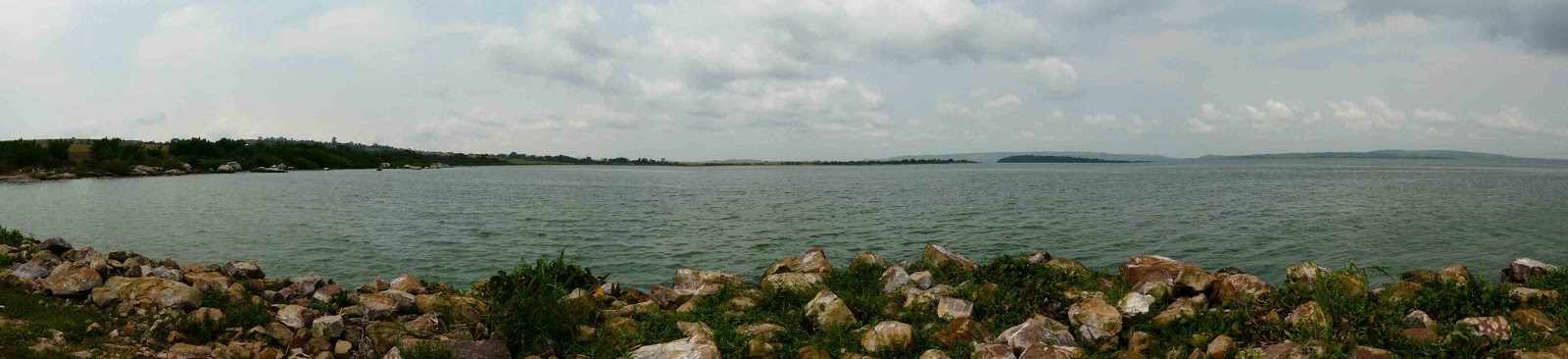
Kabanga Bay from where the ferry port will be.
As Jenny has beaten me to it (link here) I'll not go into great detail about our Rubafu trip.  Here's a map of where we went and some photos of the scenery up near the point.


Bugabo village for fish factory workers
Kyamukwenge Bay

Bukoba, 19 Feb 2011